Scytale Cipher: Encrypt, Decrypt and Find the Rod Size
Wind a message around a virtual Spartan rod and watch the strip unroll into ciphertext. Decrypt a strip when you know the rod size, or let the tool try every size from 2 to 30 and rank the results.
Rod size
What does your puzzle give you?
How many letters fit around the rod once. This is the number of rows in the grid.
4 letters per turn × 5 turns, 20 letters
Fills the rectangle exactly
Options
How the strip wraps
Reading row 1 of 4: IAMHU
Drag or swipe the rod to turn it. The framed row is the one you read along the rod.
Unrolled strip
Colors match the turns of the strip.
Ciphertext20 letters
The scytale cipher hides a message by changing the order of its letters, not the letters themselves. You wind a strip of leather or paper around a rod, write along the rod, then unwind the strip. Off the rod the letters look scrambled; wrapped around a rod of the same thickness they line up again. This scytale tool does the wrapping for you, draws the strip on the rod as you type, and works as a scytale decoder even when you don't know the rod size.
What is a scytale cipher?
A scytale (pronounced SKIT-uh-lee, from the Greek skytálē, "baton" or "staff") is a transposition cipher: every letter of the original message appears in the ciphertext, but in a different order. Compare that with a Caesar cipher, a substitution cipher that keeps the order and swaps each letter for another one.
| Scytale cipher | |
|---|---|
| Type | Transposition (letters rearranged, not replaced) |
| Key | Thickness of the rod = letters per turn of the strip |
| Possible keys for an n-letter message | 2 to n − 1 letters per turn |
| Era | Ancient Greece, best known from Sparta |
| Security today | None; every key can be tried in seconds |
The only secret in a scytale is the thickness of the rod. Anyone holding a rod of the same thickness can read the strip, and anyone without one can still try every size until the text makes sense.
How to use this scytale tool
- Choose Encrypt or Decrypt. Encrypt turns readable text into a scytale strip; Decrypt turns a strip back into text.
- Type or paste your text. By default spaces and punctuation are removed and letters are shown in capitals, the way a scytale strip was usually written. Turn that off to keep every character, including spaces, as a cell on the strip.
- Set the rod size. Pick whether you know the letters per turn or the number of turns, then enter the number. The drawing shows both values so you can check you used the right one.
- Turn the rod. The 3D rod shows the strip wound around it: each side of the rod carries one row of letters, and the strip steps slightly sideways from one side to the next, which is the spiral of the winding. Drag or swipe the rod, or use the buttons, to turn it. The framed side is the row you read along the rod. Switch to the grid view to see all rows at once as a table.
- Optional: pad the last turn. Turn on padding to fill the final turn with a filler letter (X by default) so the grid is a full rectangle.
- Copy or print. Copy the result, or use Print strip to print the ciphertext as a long paper strip you can cut out and wind around a pencil or a tube.
In decrypt mode, the panel below the result lists every possible rod size with its decoded text, ranked by how much it looks like English, so you can decode a scytale message without the key.
Letters per turn or number of turns?
Most mistakes with the scytale come from mixing up its two numbers:
- Letters per turn is how many letters fit around the rod in one lap. A thin rod holds few, a thick rod holds more. This is the real key, because the rod's thickness fixes it.
- Number of turns is how many laps the strip makes around the rod. It depends on how long the message is.
Lay the wrapped strip out as a grid and both numbers become visible. Each row runs along the length of the rod, so the number of rows equals the letters per turn. Each column is one lap of the strip, so the number of columns equals the number of turns. A message of 18 letters on a rod that holds 3 letters per turn makes 6 turns; on a rod that holds 6 letters per turn it makes 3 turns. Those two settings give different ciphertexts, which is why a puzzle that says "the key is 6" can still be decoded wrongly. If the first reading fails, try the same number as the other kind of size.
How to encrypt with the scytale cipher
Take the message MEET ME AT THE OLD GATE on a rod that holds 3 letters per turn. With spaces removed it is 18 letters, so the strip makes 18 ÷ 3 = 6 turns. Writing along the rod fills three rows of six:
| Turn 1 | Turn 2 | Turn 3 | Turn 4 | Turn 5 | Turn 6 | |
|---|---|---|---|---|---|---|
| Row 1 | M | E | E | T | M | E |
| Row 2 | A | T | T | H | E | O |
| Row 3 | L | D | G | A | T | E |
Unwinding the strip reads the grid one turn at a time, top to bottom: MAL, ETD, ETG, THA, MET, EOE. The scytale ciphertext is MALETDETGTHAMETEOE. Every letter of the original is still there; only the order changed.
The same rule as a formula
When the message fills the rod exactly, with K letters per turn and c turns, the letter at position i of the message (counting from 0) sits in row r = ⌊i ÷ c⌋ and turn t = i mod c. After unwinding, it lands at position t × K + r of the ciphertext. In the example, the second E of MEET (position 2) is in row 0, turn 2, so it moves to position 2 × 3 + 0 = 6, the seventh letter of MALETDETG… Decrypting runs the same mapping backwards.
How to decrypt a scytale cipher message
To decrypt, you wind the strip back onto a rod of the same thickness. On paper, that means writing the ciphertext into the grid turn by turn (down the columns) and reading it along the rod (across the rows).
Messages rarely fill the rod exactly, so the decoder has to know which turns are short. Take HELP IS ON THE WAY, 14 letters, with 3 letters per turn. It needs 5 turns, but 3 × 5 = 15 cells, so one cell stays empty at the end of the last row.
| Turn 1 | Turn 2 | Turn 3 | Turn 4 | Turn 5 | |
|---|---|---|---|---|---|
| Row 1 | H | E | L | P | I |
| Row 2 | S | O | N | T | H |
| Row 3 | E | W | A | Y |
The strip reads HSE EOW LNA PTY IH, so the ciphertext is HSEEOWLNAPTYIH. The empty cells are always at the end of the last row, so the last turns hold one letter fewer than the others. Here turns 1 to 4 take three letters each and turn 5 takes two. Fill the grid turn by turn with that split, read the rows, and you get HELPI SONTH EWAY again. The scytale decoder above works out this split for any message length automatically.
Decoding a scytale cipher without the rod size
A scytale has very few possible keys. A message of n letters can only have been wound with 2 to n − 1 letters per turn: one letter per turn, or as many letters per turn as the message has, would leave the text unchanged. An 18-letter message therefore has just 16 possible keys. The decrypt panel tries every size up to 30 and ranks the results.
Three clues help you pick the right reading:
- Readable words. The correct size usually stands out at once; the wrong ones stay jumbled.
- A full rectangle. If the sender padded the strip, the message length divides evenly by the right size. For 18 letters, only 2, 3, 6 and 9 letters per turn give a full rectangle, and the panel marks them.
- Normal letter frequencies. A scytale only moves letters around, so the ciphertext keeps the letter frequencies of English: plenty of E, T and A, few Q and Z. A ciphertext that looks like that but won't read is probably a transposition cipher. The frequency analysis tool shows this at a glance.
The trailing X problem
Padding the last turn with X makes the grid a neat rectangle, but it adds letters the reader has to throw away. After decrypting, the tool can strip trailing filler letters for you. Leave that switch off if the real message might end in X (a word like box or relax), because no tool can tell padding from text. Using a rarer filler such as Q, or agreeing on the message length in advance, avoids the problem.
Should you keep spaces and punctuation?
Historically, scytale strips were written without spaces, and removing them also hides where words begin and end. That is why the tool removes them by default. If you keep them, each space and punctuation mark takes a cell on the strip like a letter. The ciphertext then contains spaces in odd places, which gives the reader extra clues and makes the message longer. Both settings decode correctly as long as sender and reader use the same one.
Make a scytale for a classroom
The scytale is one of the few ciphers students can build with their hands:
- Encrypt a short message with a small number of letters per turn, such as 3 or 4.
- Use Print strip to print the ciphertext as one long strip with cut lines.
- Cut out the strip. For a long message, tape several strips end to end.
- Give the strip and a pencil, marker or cardboard tube to another group. They wind the strip at a slight angle so that each turn sits snugly against the last, then turn the rod until the letters line up into words.
A rod that is too thick or too thin makes the letters drift out of line, which shows students exactly why the thickness of the rod is the key. Ask them afterwards how many rods they would need to try to read a strip without being told the size; the answer, about as many as there are letters, is the lesson in why the scytale is not secure.
Scytale history: what the ancient sources say
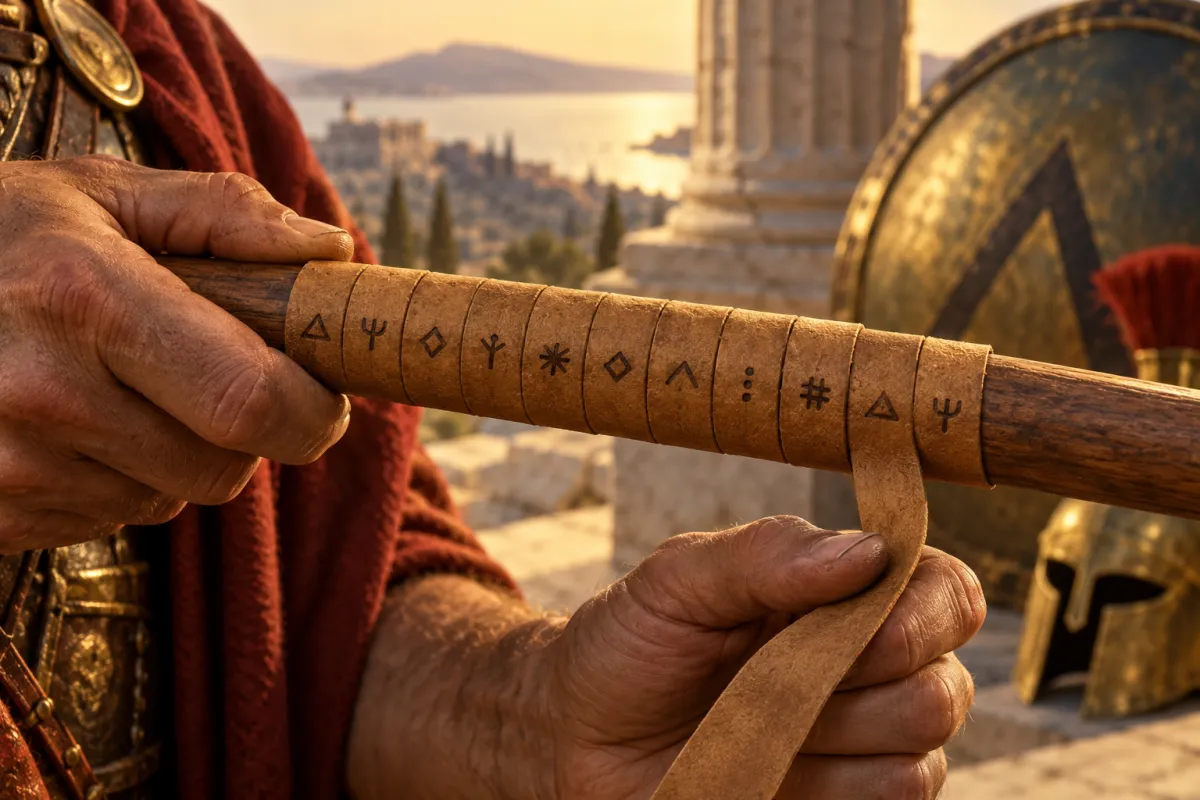
The word skytale appears in Greek writing long before the classical period, but the clearest description of the device comes much later, from Plutarch, writing around AD 100. In his Life of Lysander he describes Spartan magistrates having two rods made of exactly the same length and thickness. They kept one and gave the other to a commander leaving for war. To send orders, they wound a strip around their own rod, wrote along it, and sent the strip alone. Only the commander's matching rod could make the letters line up.
Historians still debate how much secrecy the scytale gave. Some argue it worked mainly as a way to show a message was genuine, since only the holder of the matching rod could produce a strip that read correctly. Either way, the Spartan scytale is the oldest known example of a transposition device, and its basic idea, rearranging letters by a fixed pattern, runs through later ciphers up to the 20th century.
How secure is the scytale cipher?
By modern standards, not at all. The key space is tiny, the ciphertext keeps the frequencies of the original letters, and a correct guess at the rod size reveals the whole message at once. Its value today is in teaching: the scytale is the simplest way to see the difference between transposition and substitution, and it is often the first step before stronger ciphers that combine the two.
Scytale compared with other transposition ciphers
| Cipher | How letters are rearranged | Secret | Keys to try without the secret |
|---|---|---|---|
| Scytale | Written in rows, read in columns | Letters per turn | About as many as the message has letters |
| Columnar transposition | Written in rows, columns read in keyword order | Number of columns and their order | Grows very fast with the keyword length |
| Rail fence | Written in a zigzag across several rails | Number of rails | About as many as the message has letters |
Written as a grid, a scytale is a columnar transposition whose columns are always read in their natural order, so the only secret is the grid size. Adding a keyword that shuffles the column order, as columnar transposition does, multiplies the number of possible keys and is the natural next step up from the scytale cipher.
Scytale Cipher FAQ
How do I decode a scytale cipher without the key?
Switch the tool to Decrypt and paste the ciphertext. It tries every rod size from 2 to 30 letters per turn, ranks the readings by how much they look like English, and highlights the best one. Click any row to load that rod size. Because an n-letter message has only n − 2 possible keys, the right one is usually easy to spot.
What is the key of a scytale?
The key is the thickness of the rod, expressed as the number of letters that fit around it in one turn. Puzzles sometimes give the number of turns instead. The tool accepts either and shows both on the drawing, so you can check which one your puzzle meant.
Is the scytale a substitution or a transposition cipher?
It is a transposition cipher. The ciphertext contains exactly the same letters as the message, only in a different order. That is why a scytale ciphertext keeps normal English letter frequencies, which is the quickest way to recognize one.
My decoded text is almost readable but the words are mixed up. What went wrong?
The most common cause is using the number of turns where the puzzle meant letters per turn, or the other way round. Switch the size type in the tool and decode again. The other common cause is keeping spaces on one side and removing them on the other: both sides must use the same setting.
Did the Spartans really use the scytale for secret messages?
Plutarch, writing around AD 100, describes Spartan officials sending orders on strips wound around matching rods. Historians still debate whether the scytale was mainly a way to hide messages or a way to prove a message came from the holder of the matching rod. It remains the oldest known transposition device.
What rod should I use to make a scytale at home or in class?
Anything round and even works: a pencil, a marker or a cardboard tube. Encrypt with a small number of letters per turn, such as 3 or 4, print the strip with the Print strip button, and wind it at a slight angle so each turn sits against the last. If the letters drift out of line, the rod is too thick or too thin.
Related Ciphers
Writes text in a zigzag pattern across multiple rails
Reorders text by reading keyword-sorted columns from a grid
Shifts each letter by a fixed number of positions in the alphabet
Reverses the alphabet so A becomes Z, B becomes Y, and so on